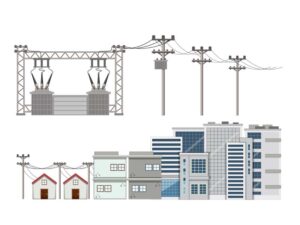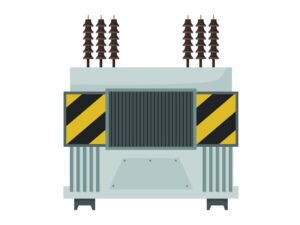
Power transformers are classified in many ways according to different classification methods, but our common transformers are often oil-immersed transformers, dry-type transformers and box-type substations. Today we will talk about the relevant knowledge of dry-type transformers.
Cooling and insulation of dry-type transformers
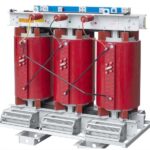
Dry-type transformer is a special type of power transformer, which is characterized by the fact that the core and windings are not immersed in insulating oil.
Then the question arises. Oil-immersed transformers rely on insulating oil for cooling and insulation. Since dry-type transformers do not have insulating oil, how do they cool and insulate?
Let’s talk about cooling first. Dry-type transformers usually have two cooling methods. One is natural air cooling (AN) . When the transformer is operating at rated capacity, it mainly relies on natural air convection for heat dissipation. At this time, there is no need to rely on additional cooling. The cooling equipment can operate continuously for a long time; the other is forced air cooling (AF). When the working environment of the transformer reaches 80 degrees, the temperature control system will automatically start the fan for forced air cooling. By forcing the air to flow, the heat dissipation efficiency of the transformer can be significantly improved, so that the transformer can still maintain normal operation in overload or high temperature environments. To put it simply, it is cooled by air flow. If the temperature is too high, a fan is used to assist in dissipating heat.
Let’s talk about insulation. Dry-type transformers mainly use epoxy resin as the insulating material, and use a variety of processes to ensure the insulation effect. Specific types include: epoxy quartz sand mixture vacuum casting type, epoxy alkali-free glass fiber reinforced vacuum pressure difference casting type , alkali-free glass fiber winding impregnated type.
The advantages of dry-type transformers:
are high safety: Dry-type transformers do not contain flammable and explosive oil products, so they are less likely to cause fire or explosion accidents during operation, which greatly improves the safety of use. At the same time, dry-type transformers have good electrical insulation properties and can effectively prevent leakage and short circuits.
Good environmental protection : Since dry-type transformers do not use oil as cooling and insulating media, they will not produce oil pollution and are environmentally friendly.
High efficiency and energy saving : During the design and manufacturing process of dry-type transformers, we pay attention to improving energy efficiency and reducing losses. By optimizing the coil structure, using high-efficiency insulation materials and advanced manufacturing processes, dry-type transformers can maintain low energy consumption and high efficiency during operation.
High reliability : Dry-type transformers use advanced manufacturing processes and materials, which have a long service life and high reliability. Under normal operating conditions, dry-type transformers have a low failure rate and can ensure stable operation of the power system.
Disadvantages of dry-type transformers:
Poor moisture and dust resistance : Dry-type transformers have relatively weak protection against moisture and dust. When used in humid or dusty environments, additional protective measures may be required, such as setting up a protective cover or building a special distribution room to protect its insulation performance.
Relatively poor ability to withstand harsh environments : Compared with oil-immersed transformers, dry-type transformers are generally more suitable for installation in indoor environments. When used outdoors, special attention needs to be paid to its protection and heat dissipation to ensure its normal operation and extend its service life.
High requirements for insulating materials: Dry-type transformers have high requirements for insulating materials and need to use materials with good thermal conductivity and insulation, such as specially treated epoxy resin. This will also increase its manufacturing cost.
Once the coil is damaged, it is difficult to repair : Once the coil of a dry-type transformer is damaged, it is usually difficult to repair it locally and needs to be replaced as a whole. This increases the complexity and cost of repairs.
Differences from oil-immersed transformers:
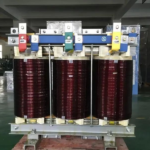
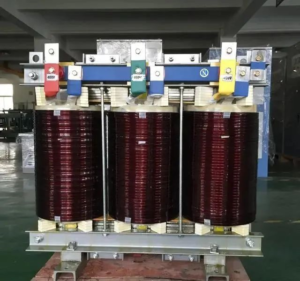
In terms of appearance , dry-type transformers and oil-immersed transformers are easy to distinguish. Oil-immersed transformers have metal casings, while dry-type transformers can visually see the core and windings.
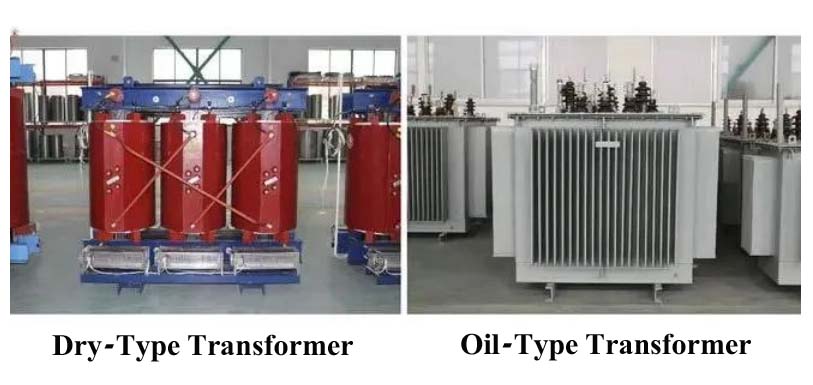
In terms of cooling and insulation , as mentioned above, oil-immersed transformers use insulating oil for cooling and insulation, while dry-type transformers use air for insulation and cooling. This is the main difference between the two.
Structurally , dry-type transformers lack insulating oil, so their size and weight are smaller than oil-immersed transformers, making them easier to transport. At the same time, the windings and iron core are not soaked in insulating oil. They are usually wrapped with multiple layers of insulating materials, and then a protective layer is added outside the insulating materials. The iron core is composed of layers of iron chips, which reduces the loss of magnetic flux.
In terms of application places , dry-type transformers are particularly suitable for installation in indoor environments due to their fire-proof and oil-free characteristics, and are mostly used in “fire-proof and explosion-proof” places; oil-immersed transformers are more suitable for installation outdoors and are used in large power systems. Widely used, such as power grid transmission, substations, etc., because of its good heat dissipation performance and ability to withstand higher loads and voltages.